 |
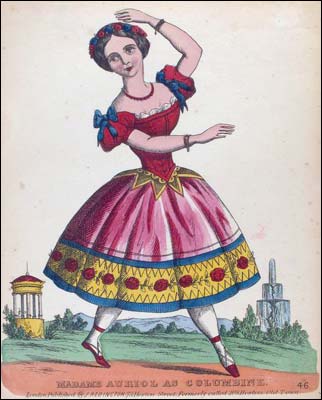 In 1804 Drury Lane introduced Cinderella as a pantomime. Most of the plots were based on the conventional nursery tale, "in which the course of true love never did run smooth", and the cross-grained father, the pretty daughter with two suitors, one wealthy and ugly, the other poor and debonair, at the touch of a fairy's wand all turn into the characters of the Harlequinade, and in the end are found in a long pursuit through a dark forest. Thackeray bears witness to the popularity of the pantomime. " Very few men in the course of nature can expect to see all the pantomimes in one season " he writes in Round About a Christmas Tree, "but I hope to the end of my life I shall never forego reading about them in that delicious sheet of the Times which appears on the morning after Boxing Day." In 1804 Drury Lane introduced Cinderella as a pantomime. Most of the plots were based on the conventional nursery tale, "in which the course of true love never did run smooth", and the cross-grained father, the pretty daughter with two suitors, one wealthy and ugly, the other poor and debonair, at the touch of a fairy's wand all turn into the characters of the Harlequinade, and in the end are found in a long pursuit through a dark forest. Thackeray bears witness to the popularity of the pantomime. " Very few men in the course of nature can expect to see all the pantomimes in one season " he writes in Round About a Christmas Tree, "but I hope to the end of my life I shall never forego reading about them in that delicious sheet of the Times which appears on the morning after Boxing Day."
The pantomimes were not mimes but very verbal performances. While one part of the performance was aimed at the children and the innocent, the verbal exchanges were often risqué or critical of government and aimed at the heads of adults. The audience often became an extra character in the plays
The pantomimes aroused peoples’ emotions One year a pantomime nearly caused a riot.
LaBelle Assemblee January 1819
THE THEATRES.
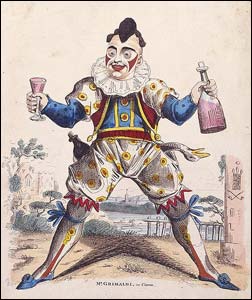 DRURY-LANE AND COVENT-GARDEN. The two Theatres have produced their usual Christmas pantomimes; one of which has been since withdrawn, whilst the other has, very deservedly, maintained its station. We have always taken much interest in spectacles which combine so many opportunities for the production of music, scenery, and personal activity, that we shall now submit a few brief observations, and which, we trust, will not be without their use to the authors of future pantomimes. Perhaps the recollection of these, or similar principles, might have rendered the present pantomime at Covent-Garden still better; and might have saved that of DruryLane from such absolute condemnation. DRURY-LANE AND COVENT-GARDEN. The two Theatres have produced their usual Christmas pantomimes; one of which has been since withdrawn, whilst the other has, very deservedly, maintained its station. We have always taken much interest in spectacles which combine so many opportunities for the production of music, scenery, and personal activity, that we shall now submit a few brief observations, and which, we trust, will not be without their use to the authors of future pantomimes. Perhaps the recollection of these, or similar principles, might have rendered the present pantomime at Covent-Garden still better; and might have saved that of DruryLane from such absolute condemnation.
It is the first quality of a pantomime to have a good portion of variety of scenery, together with those changes which shew the skill of the machinists, and afford opportunities for the wand of Harlequin.— Now no scenery is so pleasing to the inhabitants of capital cities, and particularly in the winter season, as rural scenes and country images; hence the.first description of scenery in a pantomime is certainly that of villages, woods, and fields, country towns, &c. and it was chiefly, indeed, to scenes of this character that Mother Goose owed its long popularity. The scenery, as we remember it, in that pantomime, was delightful; the river, the bridge, the country church, and the setting sun, were alike pleasing to every eye; and the country squire, with his wife, his whip, his dogs, his hounds, and his huntsmen, recalled both the images and pleasures of rural life, awakened the recollection of the elders, and amused the children by an incessant motion and bustle. The Covent-Garden pantomime had one beautiful scene of this nature —the Italian Village and Mountain, a snow storm, and a thaw.
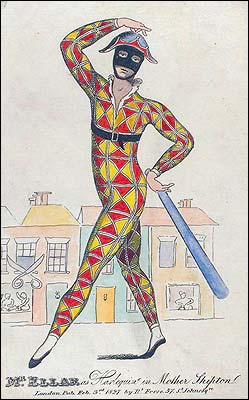 The next character of scenery suited to a pantomime is that of those which are visited in our panoramas,—in other words, the capitals of distant countries. The only question here is selection; and as facts speak more intelligibly than rules, we would always advise those who get up these spectacles to put this question to themselves—Why are the panoramas in our metropolis so much visited, and so profitable to their proprietors ? Why does every one run to see Athens, Waterloo, &c. ?— Simply, because every one wishes to see in a picture what he has so frequently desired to visit in reality ; because, in the next degree to the actual sight of a thing, the imaginary presence of it in a picture is pleasing; every one wishes to see those images of which he delights to read ; and what books are more eagerly read than books of travels. A good pantomime, therefore, should give panoramas of foreign cities, and foreign scenery, and more especially of such foreign scenes and images, as happen to occupy public attention. The Covent-Garden pantomime is excellent in this respect. Constantinople—the Bay of Dublin——College-green, Dublin—the view near Alexandria—all these were excellent, and were the chief, indeed the sole causes that this pantomime is attractive. In tricks it falls short of many which have preceded it In scenery it is equal to any of them. The author of it has exhibited so much taste and knowledge in this department, that we will undertake to promise him, that, governing himself upon these principles, he incurs no risk of having his pantomime condemned. The Drury-Lane pantomime was most miserably deficient in this kind of scenery, and the total absence of it was the main cause of its ill success. It had not, as we remember, one good scene. The next character of scenery suited to a pantomime is that of those which are visited in our panoramas,—in other words, the capitals of distant countries. The only question here is selection; and as facts speak more intelligibly than rules, we would always advise those who get up these spectacles to put this question to themselves—Why are the panoramas in our metropolis so much visited, and so profitable to their proprietors ? Why does every one run to see Athens, Waterloo, &c. ?— Simply, because every one wishes to see in a picture what he has so frequently desired to visit in reality ; because, in the next degree to the actual sight of a thing, the imaginary presence of it in a picture is pleasing; every one wishes to see those images of which he delights to read ; and what books are more eagerly read than books of travels. A good pantomime, therefore, should give panoramas of foreign cities, and foreign scenery, and more especially of such foreign scenes and images, as happen to occupy public attention. The Covent-Garden pantomime is excellent in this respect. Constantinople—the Bay of Dublin——College-green, Dublin—the view near Alexandria—all these were excellent, and were the chief, indeed the sole causes that this pantomime is attractive. In tricks it falls short of many which have preceded it In scenery it is equal to any of them. The author of it has exhibited so much taste and knowledge in this department, that we will undertake to promise him, that, governing himself upon these principles, he incurs no risk of having his pantomime condemned. The Drury-Lane pantomime was most miserably deficient in this kind of scenery, and the total absence of it was the main cause of its ill success. It had not, as we remember, one good scene.
From the ill-success of the Drury-Lane pantomime, we do not conceive it necessary to give its plot. The cause of its being withdrawn will be found in the following account of the circumstances which ensued upon its repetition :—
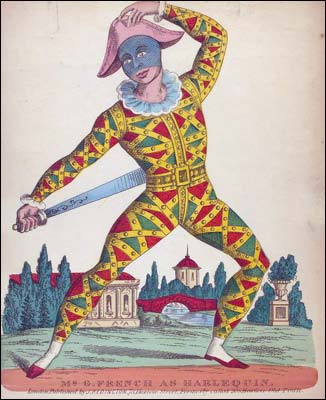 After the curtain dropped on Monday evening, the 28th of December, a considerable part of the audience remained, particularly in the pit and the galleries, and called loudly for the manager. Mr. S. Kemble at length appeared, and expressed his wish to know the pleasure of the audience. He was replied to by a general call of " withdraw, withdraw the pantomime." Mr. Kemble then said, that it was always the anxious desire of the proprietors and managers of that theatre to comply with the wishes of the public. He hoped, however, that as the bills, announcing the pantomime for the following evening, were already printed, and as there was reason to hope that such alterations might be made as would render it acceptable, that its repetition would be permitted. This address produced no abatement of the storm. The cry of "withdraw" was still loudly repeated, and Mr. Stephen Kemble again came forward. As soon as he could obtain hearing, be observed, that be understood Mr. Bradbury had, on the Saturday, given some offence. if that was the case, be was sure nobody could more regret it than Mr. Bradbury.— After the curtain dropped on Monday evening, the 28th of December, a considerable part of the audience remained, particularly in the pit and the galleries, and called loudly for the manager. Mr. S. Kemble at length appeared, and expressed his wish to know the pleasure of the audience. He was replied to by a general call of " withdraw, withdraw the pantomime." Mr. Kemble then said, that it was always the anxious desire of the proprietors and managers of that theatre to comply with the wishes of the public. He hoped, however, that as the bills, announcing the pantomime for the following evening, were already printed, and as there was reason to hope that such alterations might be made as would render it acceptable, that its repetition would be permitted. This address produced no abatement of the storm. The cry of "withdraw" was still loudly repeated, and Mr. Stephen Kemble again came forward. As soon as he could obtain hearing, be observed, that be understood Mr. Bradbury had, on the Saturday, given some offence. if that was the case, be was sure nobody could more regret it than Mr. Bradbury.—
"Let Mr. Bradbury appear and answer for himself," was now the general cry. Mr. Kemble retired. After come minutes had elapsed, considerable impatience was shown for the appearance of Mr. Bradbury, and Mr. Kemble returned once more to the stage, to state, that when the pleasure of the audience was intimated to Mr. Bradbury, he was changing his dress; but that he would obey the call which had been made upon him as speedily as possible. Soon after this Mr. Bradbury came forward. He stated, as far as we could hear, that he was sorry to understand he had been the object of the displeasure of some of the audience ; that it never was his intention to offend any individual whatever; and that he should infinitely regret it, if any thing he had done had given just cause of offence. After this address, Mr. Bradbury was spoken to from one of the boxes near the stage, and a conversation took place between him and some gentlemen in the box. He was told that the gentleman whom he had affronted on Saturday night was gone. Mr. Bradbury replied, that he was ready to meet that gentleman, or any other on earth. This was followed by considerable applause, and he withdrew. A few remained for some time calling for the manager; but as he did not again come forward, they also retired. On the following evening this theatre again exhibited a scene of the greatest uproar and confusion. No less, indeed, was anticipated, from the unsatisfactory termination of the differences of the preceding evening. The commencement of the pantomime was the signal for the renewal of hostilities. The actors were received throughout with the most violent disapprobation ; the only exception to this was the reception which a solo on the flageolet, by Miss Tree, met with, which was encored. Mr. Bradbury, who had been so unfortunate as to incur the displeasure of the audience, made the most expressive signs to signify his wish to address them, and at last fell down on his knees, but all without effect. The pantomime was abridged as much as possible, and brought to an end by about twenty minutes past ten o'clock, but the greatest part of the audience still remained in the theatre. The uproar then became more violent. Two or three attempts were made to extinguish the lights; but this was always accompanied by demonstrations on the part of the audience which rendered a renewal of the lights necessary. Mr. Stephen Kemble made his appearance about eleven o'clock, and after expressing his regret that any cause of displeasure should have been afforded, stated that the pantomime would be withdrawn, and announced a farce for the following evening. This piece of information was so far acceptable, that it emptied the theatre of the greatest part of the audience. A party, however, still remained, making up by determination for what was wanted in numbers, and the row was kept up with more or less briskness till near twelve o'clock. Some were for coming to a determination never to allow Mr. Bradbury to reappear on the boards, while others condemned this resolution to deprive any individual of bread as harsh and unjustifiable. Mr. M'Naughten was present in one of the boxes, and made several attempts to speak. We had not the advantage of hearing him, but we were informed that he expressed himself perfectly satisfied with the explanations which he had received from Mr. Bradbury, who bowed respectfully to him. A gentleman in one of the upper boxes, who from his appearance was erroneously taken by a part of the audience for Mr. Wooler, spoke in favour of Mr Bradbury; and a female orator exclaimed with great vehemence against the attempt to run down the pantomime by such unfair means. Attempts were made to tear up the seats, and otherwise injure the theatre; but we do not conceive that any great injury was done in this way.
----
Some performances mentioned in other periodicals are Jack and the Beanstalk; Don Quixote; Harlequin and the Dragon of W: Harlequin and the Dandy Club; Harlequin Munchausen.
|
|

