|
The child born to an unmarried mother knew from the beginning
that he was illegitimate; those declared illegitimate later in
life had to deal with the ramifications of such a label as adults
after they had probably married or received legacies.
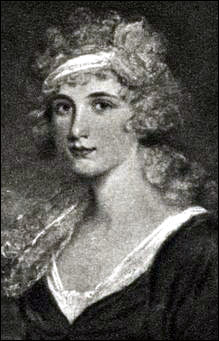 |
| The famous actress, Dorothy Jordan,
had numerous illegitimate children with several men, including
ten illegitimate children with the Duke of Clarence. |
The Hardwicke marriage act , paragraph 11 , says that marriages
of minors, marrying by license , without permission of the father
or guardian or a guardian appointed by the court of Chancery were
absolutely invalid. The need for permission from a father was
a problem for an illegitimate child who had a biological but no
legal father. The courts subsequently interpreted this clause
as saying that all minor illegitimate children had to have the
permission of a guardian appointed by the Court of Chancery if
they married by license as minors.
The dissolution of several marriages of fifteen to twenty-seven
years duration, with the bastardization of the children and sometimes
those of thegrandchildren , aroused strong protests.
If a couple’s marriage was declared void from the onset,
then none of their children were legitimate. If any of their children
had married by license when minors , even with the permission
of the father, such a marriage was also invalid and all children
illegitimate. Remember , the father of an illegitimate child had
no authority to grant permission for a marriage by license.
Also, if a child had received a legacy from a relative based
on a relationship to the person-- inherited because he was a nephew
or because the oldest son of the marriage-- such legacy was invalid.
While an illegitimate child was no longer barred from being ordained
or moving in society, the child faced difficulties a legitimate
child did not. A person who discovers that he is illegitimate
in adulthood and then discovers that his own marriage is probably
invalid and his own children illegitimate can be overwhelmed with
shock.
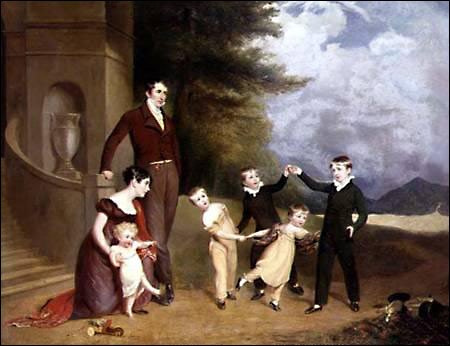
When Lady Harriet Cavendish, daughter
of the Duke and Duchess of Devonshire, married Lord Granville,
she took in the two illegitimate boys her husband had fathered
with her aunt.
Efforts were made to change the law but met strong opposition
from the faction which insisted on a father having the right to
approve or disapprove of a child’s marriage. While commiseration
was expressed by them for the adult children whose lives were
disarranged, they felt that the numbers were not great enough
to warrant a wholesale change to the law.
The Donegal case changed their minds and in 1822 the law was
changed . All marriages of minors by license without proper permission,
not already decided by a judge, were declared valid if the couple
stayed together. Any couple who wished to end such a marriage
could.
 If
the parents decided to separate, and did so within a specific
time period, parliament declared their children legitimate. This
was a one time offer and referred only to those who took advantage
of the provisions of the act. The children involved in cases already
decided or those whose marriages were declared invalid for other
reasons or in the future were not covered by this amnesty. If
the parents decided to separate, and did so within a specific
time period, parliament declared their children legitimate. This
was a one time offer and referred only to those who took advantage
of the provisions of the act. The children involved in cases already
decided or those whose marriages were declared invalid for other
reasons or in the future were not covered by this amnesty.
A child born to a married woman was legitimate and considered
the husband’s unless he took active steps to disown the child
before it was born or at its birth. If he were away at the time
of the conception he had to accuse his wife of adultery and divorce
her.
The Duchess of Devonshire was sent away under a false name to
have her child by Lord Grey. The child was immediately taken from
her and given up to be raised by others.
|


 To
Be the Earl of Berkeley; New York Times Archive 1891
To
Be the Earl of Berkeley; New York Times Archive 1891