|
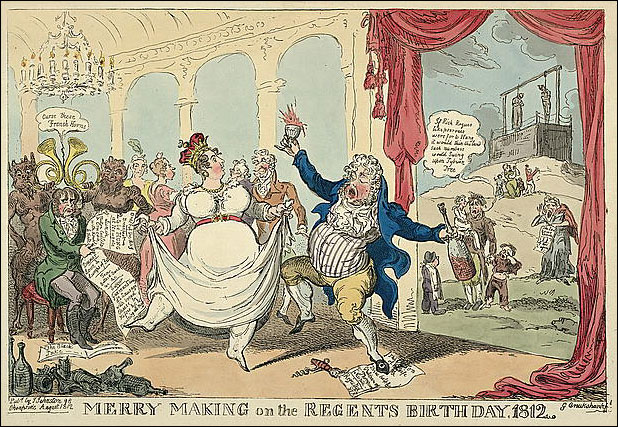
Hogarth of the eighteenth century and Isaac
Cruishank, Gillray and Rowlandson in the early nineteenth were
well-known for their satirical pictures and were the mainstay
of print shops such as Mrs. Humphrey's . Gillay and I. Cruishanks
died around 1810-1811 and Thos. Rowlandson in 1827 but George
Cruishanks was to draw well into the century.
 The
caricature prints were in the form of an etching about 8" x 12
1/2" that was sold uncoloured for 1s and 2s 6d for the hand coloured. The
caricature prints were in the form of an etching about 8" x 12
1/2" that was sold uncoloured for 1s and 2s 6d for the hand coloured.
Illustrations of any size in newspapers did
not become usual until improvements in the presses made them possible
in the 1840's. Even then the more sober English newspapers used
few illustrations. They left that process to such papers as Illustrated
London News, Illustrated London Life and the Illustrated Weekly
Times.
Before the advent of the pulp papers, only
the fashion journals were likely to have many illustrations; those
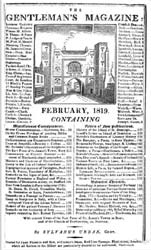
appealing primarily to men, were not. The Gentleman's Magazine,
one of the leading non-literary magazines of the day, is sparsely
illustrated.
It may have been this early distinction--
magazine's for gentlemen without illustrations and those for women
with-- that germinated the idea that women's magazines were somehow
of lesser quality than those for men.
Prints and broadsides made up for any lack
of illustrations in newspapers and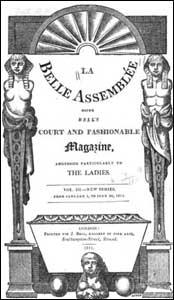 were readily and inexpensively available. Broadsheets were one
page publications that contained advertisement, political satires,
political cartoons, patriotic verses and news of great victories
or disasters. In many ways these broadsheets were a combination
of a daily newspaper and the National Enquirer. They had neither
a schedule of publication nor subscribers.
were readily and inexpensively available. Broadsheets were one
page publications that contained advertisement, political satires,
political cartoons, patriotic verses and news of great victories
or disasters. In many ways these broadsheets were a combination
of a daily newspaper and the National Enquirer. They had neither
a schedule of publication nor subscribers.
Chapbooks were cheap publications that might
be thought of as the paperback books of the day. These books covered
a wide range of subjects from the alphabet for children to hints
to the housewife. Some of them were longer versions of broadsheets.
Many were pirated or parodied copies of popular literature. They
were sold by vendors who carried them in a tray before them in
town or in their wagon when they traveled from town to town. These
and the lending libraries made the printed word widely accessible.
A reference used:
Williams, Keith. The English Newspaper.
London: Springwood Books,1977.
 Magazines
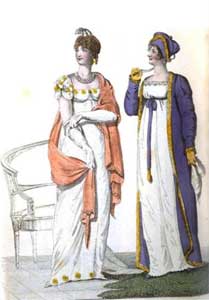
such as The Ladies Monthly Museum carried one or two fashion
illustrations along with book reviews and articles of interest
to an educated female. Others devoted themselves more to poetry
and inspirational works. Then as now, the ladies magazines devoted
much space to telling women how to bring up their children, how
to deal with their husbands, and how to dress. Articles on political
or military events were rare. Women, whose husbands took control
of their money after marriage, could not always afford to buy
the magazines that were available. The field of publications for
women started small but grew steadily. One publication brought
out a sort of yearly diary-calendar with fashion forecasts and
articles on various aspects of daily life. Magazines
such as The Ladies Monthly Museum carried one or two fashion
illustrations along with book reviews and articles of interest
to an educated female. Others devoted themselves more to poetry
and inspirational works. Then as now, the ladies magazines devoted
much space to telling women how to bring up their children, how
to deal with their husbands, and how to dress. Articles on political
or military events were rare. Women, whose husbands took control
of their money after marriage, could not always afford to buy
the magazines that were available. The field of publications for
women started small but grew steadily. One publication brought
out a sort of yearly diary-calendar with fashion forecasts and
articles on various aspects of daily life.
The Ladies' Magazine, or Entertaining
Companion for the Fair Sex, Appropriated Solely for their use
and Amusement. 1769-1840.
The Ladies' Monthly Museum, Or Polite
Repository of Amusement and Instruction, being an assemblage of
whatever can tend to please the Fancy, interest the Mind, or exalt
the Character of the British Fair. 1798-1838
La Belle Assemblee, addressed particularly
to the Ladies. 1806-1860's
 Newspapers
and Magazines Circulation Newspapers
and Magazines Circulation
Illustrations
In Newspapers and Magazines
A
Column from the Morning Post and Gazetteer
Review of a book by Mrs. Taylor
|